
01Read the grade as a nitrogen declaration
Urea ammonium nitrate is a liquid fertilizer containing urea nitrogen, ammonium nitrogen and nitrate nitrogen. The grade number describes total nitrogen as a percentage of the solution’s mass. It does not mean that the solution contains that percentage of urea alone.
Yongchang’s current catalogue uses the declarations below. Keep the minimum sign attached to UAN 32 when copying the specification into an enquiry. UAN 28 and UAN 30 are shown as 28% and 30%; the sales specification should state the acceptance limits that apply to an order.
Review the individual UAN 28, UAN 30 and UAN 32 specifications when defining the grade for your order.
| Grade | Catalogue total nitrogen | Nitrogen per metric tonne |
|---|---|---|
| UAN 28 | 28% | 280 kg N |
| UAN 30 | 30% | 300 kg N |
| UAN 32 | ≥32.0% | At least 320 kg N |
A metric tonne is 1,000 kg. These are catalogue-based nutrient calculations, not the results of a particular batch analysis.
Sources: [1]
02Put quotations on the same nutrient basis
For a fixed nitrogen requirement, divide the required kilograms of N by the declared nitrogen fraction. For example, a purchasing requirement of 1,000 kg N corresponds to about 3,571 kg of 28% solution, 3,333 kg of 30% solution or 3,125 kg of 32% solution. This is a quantity comparison, not a field application recommendation.
To compare prices, divide the delivered price per tonne of solution by its kilograms of nitrogen per tonne. Keep the currency, delivery point, included charges and specification basis the same. Use 320 kg N per tonne when making a conservative comparison against a 32.0% minimum declaration, rather than borrowing a higher result from an unrelated COA.
Volume is a separate calculation. A litre of UAN is not a kilogram of UAN. If your tank, pump or quotation is specified in litres, request the density and its reference temperature for the offered grade before converting between mass and volume.
03Check the conditions your supply chain must handle
Give the supplier the expected minimum storage temperature, time in storage, receiving-tank details and unloading arrangement. Ask for the storage guidance that applies to the actual grade. A grade name alone is not evidence of a guaranteed storage-temperature range.
Confirm the available storage volume against the proposed delivery, including any material already in the tank. Review materials, pumps, hoses and seals with the equipment supplier using the current product documents. If changing grades, check whether the existing metering setup needs recalibration.
- Expected storage temperatures and duration
- Available receiving capacity and unloading connections
- Grade-specific density, storage guidance and SDS
- Equipment review and calibration arrangements
04Keep the nitrogen plan separate from the grade choice
The crop’s nitrogen requirement is expressed as an amount of nutrient. The UAN concentration determines how much product carries that amount. Avoid assigning UAN 28, 30 or 32 automatically to a particular crop stage simply because of the number on the label.
Timing and placement still matter. Iowa State University Extension identifies nitrogen-loss and leaf-injury considerations for UAN applications. Discuss those conditions with your agronomist; choosing a higher concentration does not remove the need for an application plan.
Use the UAN application planning questions to prepare the discussion about timing, placement and equipment.
Sources: [3]
05Confirm one complete grade-specific offer
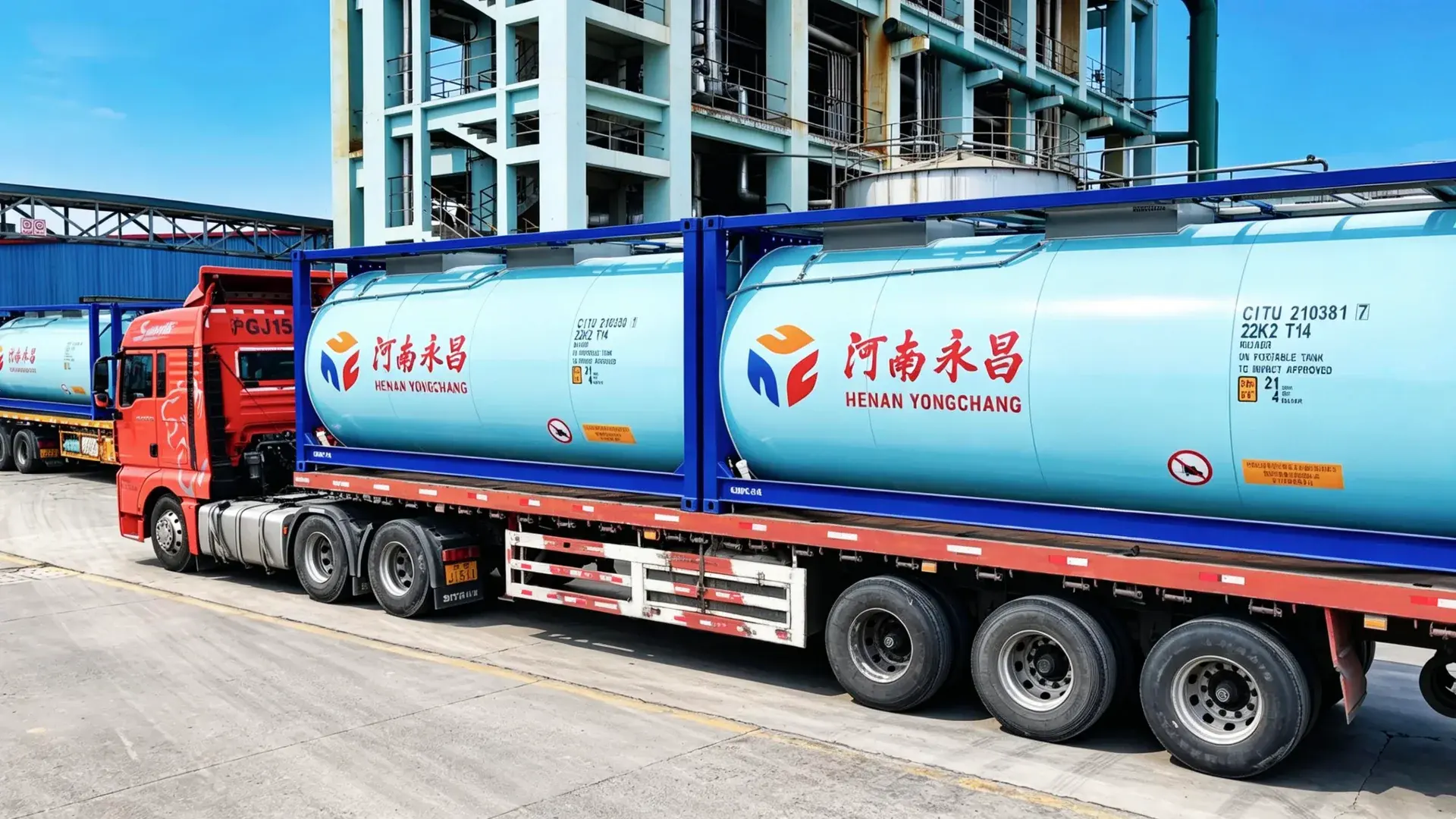
Yongchang lists ISO tank and IBC packaging for UAN, with a minimum order of one full container load. Ask for the net product mass, packaging arrangement and destination-specific delivery terms in the same quotation. One FCL does not represent a fixed number of tonnes for every shipment.
Before accepting the offer, align the grade, total nitrogen declaration, quantity basis and documents. Request the sales specification and current SDS, then agree which batch COA will accompany the supplied material. Use the same information in your purchase order and receiving checklist.
The UAN container enquiry guide brings those product and delivery requirements into one purchasing brief.
Sources & product documents
- Yongchang — UAN product specifications
Current catalogue declarations and grade-specific product pages.
- Yongchang — Shipping & logistics
One FCL minimum order, port options and shipment-specific loading arrangements.
- Iowa State University Extension — Management needs of fertilizer products (opens in a new tab)
General UAN application and nitrogen-loss considerations; not a Yongchang product test.